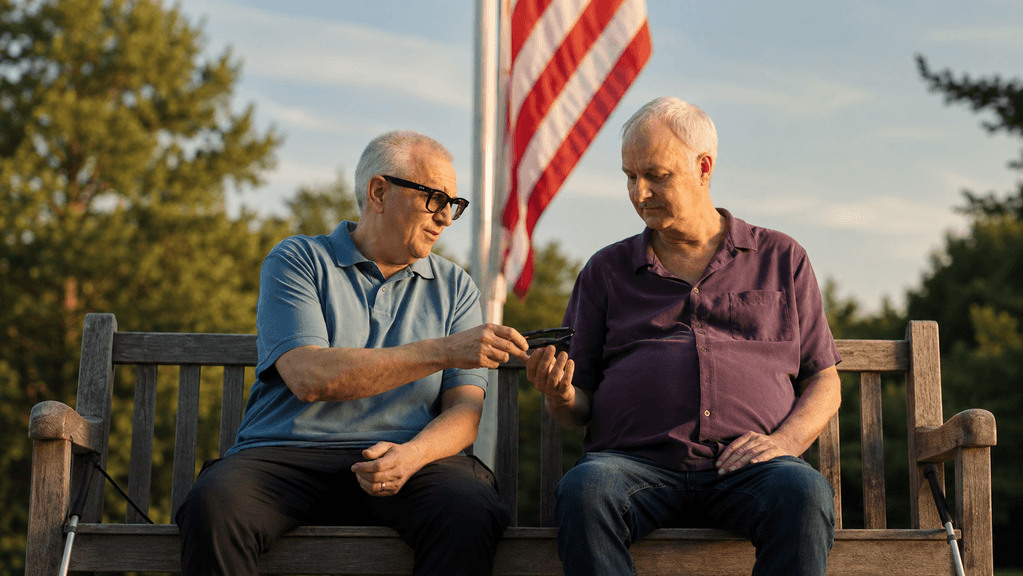
Meta’s decision to provide free Ray-Ban Meta AI glasses to legally blind veterans in the United States marks a striking moment in assistive technology. The program, announced in June 2026, offers eligible veterans a pair of AI-enabled smart glasses at no cost, with training support through the Blinded Veterans Association and other partners.
The initiative was inspired by U.S. Army veteran Don Overton, who served in the 82nd Airborne and has spoken publicly about how AI glasses helped him regain a measure of independence in daily life. For veterans living with blindness or low vision, the promise is direct: a lightweight wearable device that can read text, describe surroundings, identify objects, and connect users to visual assistance without requiring them to hold a phone.
For readers following health technology, the Meta program raises a broader question about disability access, aging veterans, and the future of AI in everyday public-health support. Smart glasses are no longer just consumer electronics. In this case, they are becoming mobility tools, reading aids, confidence builders, and part of a larger debate over who receives access to new technology first.
What Meta Is Offering Blind Veterans
Meta says the program will provide Ray-Ban Meta AI glasses to every eligible legally blind veteran in America. Reports on the rollout estimate that more than 130,000 U.S. veterans may qualify, making the program one of the largest public-facing deployments of AI wearables for people with vision loss.
The glasses combine cameras, microphones, speakers, and Meta AI voice features inside frames that resemble ordinary eyewear. A user can ask the glasses what is in front of them, request help reading a document, identify a product, check signs, or connect to outside visual assistance. The interaction is hands-free, which matters deeply for people who may already be using a cane, guide dog, walker, wheelchair, grocery bag, medication container, or mobility aid.
Meta’s official announcement framed the effort as a free program for blind veterans, with hands-on training attached to every pair. That training piece is not a minor detail. A device can be powerful and still fail a user if setup, voice commands, charging routines, privacy controls, or troubleshooting feel confusing.
| Program Detail | Why It Matters |
|---|---|
| Free Ray-Ban Meta AI glasses | Removes the purchase barrier for eligible blind veterans |
| Legally blind veteran eligibility | Targets a population with clear disability-access needs |
| Training through veteran partners | Helps users learn the device in practical settings |
| Hands-free AI assistance | Supports reading, object recognition, and daily orientation |
| Wearable format | Keeps both hands free for mobility tools or household tasks |
Why Hands-Free AI Matters For Vision Loss
Blindness changes how everyday tasks are planned. Reading a label, checking mail, recognizing a room number, finding a product on a shelf, or identifying a dropped object can require extra time, assistance, or a separate device. Smartphones already provide powerful accessibility tools, but phones still have to be held, unlocked, aimed, and managed through touch or voice.
Glasses shift that interaction closer to the user’s natural field of movement. The camera sees from the wearer’s point of view. The microphone receives voice commands. The speakers provide audio feedback. For someone with low vision, that means a document on a counter, a medicine bottle in a hand, or a sign near a doorway can become readable through a short spoken request.
Meta’s accessibility page describes AI glasses as tools that can read text, identify objects, describe surroundings, and connect blind or low-vision users to real-time help through Be My Eyes, the volunteer visual-assistance network. That external support layer is significant. AI may be fast, but human judgment still matters for unclear labels, sensitive settings, or tasks where context is hard to interpret.
The result is a hybrid model: machine vision for routine tasks, human assistance for moments that require care, nuance, or confirmation.
Don Overton And The Human Case For Wearable AI
The Meta program has been linked publicly to the experience of Don Overton, a U.S. Army veteran whose story helped shape the initiative. His example gives the rollout a human center rather than a purely technical one.
For blind veterans, independence is often built through many small victories. Reading a letter without waiting for someone else. Finding the right item in a kitchen. Understanding what is happening in a room. Moving through a public space with more confidence. These are not abstract conveniences. They affect privacy, dignity, family life, mental health, and the ability to participate in ordinary routines.
Veterans with vision loss may face layered challenges. Some live with injuries connected to military service. Others experience age-related vision loss after service. Many manage multiple health conditions at once. Access to a wearable visual assistant will not erase those challenges, but it can reduce friction at points where daily life becomes slower, more dependent, or more isolating.
That is why the word “free” matters. Assistive technology can be expensive. Training can be hard to reach. Devices may require insurance approval, nonprofit help, or personal savings. A direct donation program bypasses some of that delay and puts the technology into the hands of people who may benefit now.
The Role Of The Blinded Veterans Association
The Blinded Veterans Association is central to the program’s credibility. A device program aimed at blind veterans needs more than product distribution. It needs trust, peer support, accessible training, and sensitivity to the realities of vision loss.
The organization’s role can help close the gap between a technology company’s promise and a veteran’s daily use. Training can cover how to ask the glasses useful questions, how to manage privacy settings, how to connect with support, and how to treat AI responses as helpful cues rather than absolute truth.
The BVA’s involvement may also help reach veterans who are not active technology users. Some older veterans may be skeptical of AI or unfamiliar with smart glasses. Others may have tried accessibility devices that were too expensive, too complicated, or too fragile for regular life. Peer-led guidance can make adoption feel less like a product handoff and more like a supported transition.
What The Glasses Can And Cannot Do
Ray-Ban Meta AI glasses can support many daily tasks, but they are not a replacement for orientation and mobility training, guide dogs, canes, screen readers, braille literacy, clinical care, or human support. Their value sits in the middle: fast environmental description and hands-free access to information.
| Daily Task | How AI Glasses May Help | Limit To Watch |
| Reading mail or labels | Can read visible text aloud | Poor lighting or folded paper may reduce accuracy |
| Identifying objects | Can describe items in front of the camera | Similar objects may be confused |
| Moving through public spaces | Can describe surroundings or signs | Should not replace mobility training |
| Household routines | Can help locate items or check packaging | AI may miss hazards outside camera view |
| Getting live help | Can connect users to human visual assistance | Requires connection, setup, and user comfort |
The most responsible use is layered support. A veteran can use the glasses for quick information, then rely on training, mobility skills, human support, or professional services for higher-risk tasks. AI can help describe the environment, but it should not become the sole safety system.
The Privacy Question Around Camera-Based Assistance
Any wearable camera raises privacy concerns. For blind users, cameras can provide access to information that sighted people receive constantly. For bystanders, cameras can feel intrusive in public or private settings. That tension will shape public acceptance of AI glasses.
Meta’s program places the issue in a sensitive context. The users are veterans with disabilities, a group with strong claims to access and independence. Yet the technology relies on microphones, cameras, cloud-connected AI features, and sometimes third-party assistance. Patients, families, caregivers, store workers, and strangers may all encounter the device in daily life.
Privacy design has to be clear. Users need to know when images or audio are processed, what data is stored, how to disable features, how visual-assistance calls work, and what bystanders can see. Training should cover social norms too, such as using the device in medical offices, banks, schools, bathrooms, or private homes.
Accessibility and privacy are not opposing goals. The strongest assistive technology protects the user’s independence and the public’s trust at the same time.
A Bigger Test For AI Accessibility
The Meta glasses program arrives during a broader shift in AI hardware. Phones and laptops brought digital accessibility into software. Smart glasses move AI into the physical environment, where a person can ask for help in real time.
That shift carries high stakes for disability rights. If AI wearables become reliable, affordable, and well-supported, they could help close gaps in access to printed text, visual cues, product information, transportation details, and public spaces. If they remain expensive, poorly trained, or controlled by companies without strong accountability, they could deepen inequality.
The veteran program is a useful stress test. It targets a defined population, includes training, and centers practical needs rather than abstract technical ambition. Success should be measured by outcomes that matter to users: fewer daily barriers, more confidence outside the home, reduced dependence for routine tasks, and stronger connection to community life.
The Human Measure Of The Program
The story of Meta’s free AI glasses for blind veterans is larger than one device launch. It is about whether AI can meet people where disability, aging, service, health, and independence overlap.
For a blind veteran, the value of the glasses may appear in a moment that seems small to everyone else: reading a birthday card, identifying a can of soup, checking a street sign, sorting medication, or knowing who just walked into the room. Those moments add up. They shape privacy. They shape confidence. They shape whether technology feels distant or deeply personal.
Meta’s program will draw attention from veterans’ groups, disability advocates, privacy researchers, and health-technology observers. The early promise is real, but the standard should remain grounded. Free access is a strong first step. Training, transparency, reliability, and long-term support will decide whether these glasses become a lasting tool for independence.
For blind veterans, AI glasses are not about spectacle. They are about reclaiming pieces of daily life that vision loss can quietly take away.