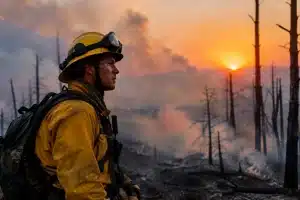
Forest Service Reorganization became one of the most consequential federal land-management changes of 2026, as the U.S. Department of Agriculture announced on March 31, 2026, that it would move the U.S. Forest Service headquarters from Washington, D.C., to Salt Lake City, Utah. The stated aim was to place leadership closer to western forests and communities facing wildfire risk. The same plan eliminated regional offices and shifted the agency toward state-based leadership.
The change did not occur in isolation. It came after years in which wildfire response, hazardous fuels work, drought, pests, and climate adaptation placed growing strain on federal land agencies. The record provided for the 2026 changes shows a government trying to reduce distance between headquarters and field decisions while also separating much of federal wildland fire management into a new structure. Whether that improves outcomes depends on execution, staffing, research capacity, and congressional funding decisions.
What The Forest Service Reorganization Changed
Headquarters And Field Authority
The headquarters move to Salt Lake City was presented by USDA as part of a “common-sense forest management” approach. The announcement was political in form but administrative in substance: it changed where senior leadership would be based and altered the structure beneath that leadership. Under the 2026 plan, the Forest Service’s regional offices were eliminated, and leadership was shifted toward a state-based model.
That state-based model may make some decisions closer to governors, state foresters, county officials, tribes, and local land managers. It may also alter long-standing internal lines of authority. The Forest Service had historically used regional offices to manage large ecological and administrative areas. Replacing that system with state-level leadership could make accountability clearer for some stakeholders, but it may also raise coordination questions where fires, watersheds, insects, smoke, and habitat cross state lines.
Forest Service Reorganization And Agency Staff
The Forest Service Reorganization also had a direct workforce dimension. The research record states that about 500 of the agency’s roughly 30,000 employees, or about 1.5 percent, were required to relocate because of the headquarters move and other structural changes. That is a limited share of the workforce in percentage terms, but relocations can still affect institutional memory, staff retention, families, and specialized program offices.
Administrative reorganizations often look cleaner on paper than they feel inside an agency. The central question is not only how many employees move. It is whether the people with the needed fire, science, contracting, engineering, and community-engagement expertise remain in positions where they can act quickly. For public lands, the cost of delay can appear during a burn window, a post-fire flooding event, or a missed opportunity for hazardous fuels treatment.
Fire Funding Moved Into A New Federal Structure
The U.S. Wildland Fire Service Budget Shift
A second major change was the creation of the U.S. Wildland Fire Service within the Department of the Interior on January 12, 2026. The research record describes it as a unified structure for wildland fire management programs from Interior and Agriculture, overseeing fire responsibilities across roughly 700 million acres managed by DOI and the Forest Service. That shift placed federal fire operations in a different budget and management setting from the traditional Forest Service structure.
The Department of the Interior’s FY2026 budget justification listed $3.7 billion for operations of the new U.S. Wildland Fire Service and $2.85 billion for the Wildfire Suppression Operations Reserve Fund, according to the official USWFS budget justification. Those figures reflected a request, not a statement that every proposed dollar had been enacted.
Forest Service Reorganization And Wildfire Capacity
For the Forest Service Reorganization, the budget transfer matters because suppression, preparedness, and hazardous fuels work are tied to different parts of the federal system. The Forest Service’s FY2026 budget justification showed that its direct budget for hazardous fuels treatments ended under the request, with hazardous fuels funding instead requested through the DOI’s U.S. Wildland Fire Service. The Forest Service document showed about $175.45 million budgeted for hazardous fuels in FY2025, followed by a sharply reduced FY2026 obligation due to that shift, as described in the Forest Service budget justification.
That does not prove that hazardous fuels work was abandoned. It shows that the budget line moved. The policy risk is transparency: Congress, watchdogs, states, tribes, and communities need to see whether treatments are funded, where they are occurring, and how outcomes are measured after the accounting structure changes.
Science Capacity Became The Central Risk
Research Facilities And Climate Adaptation
The most contested part of the reorganization record involved research capacity. As of early 2026, the agency planned to close 57 of its 77 research facilities across 31 states. The research facilities were connected to work on wildfire risk, drought, pests, and climate adaptation. The record provided here describes those closures as planned; it does not establish from the cited material how many had been completed by November 5, 2026.
That distinction matters. A planned closure can still change behavior inside an agency before the doors close. Scientists may leave, long-term studies may be paused, field plots may lose support, and partners may question whether to begin new work. In forest science, many useful datasets depend on years of consistent measurement. Fire behavior, insect outbreaks, drought stress, and regeneration patterns rarely fit into short budget cycles.
What Could Be Lost Or Gained
There is a defensible argument for reducing duplication and moving scientists closer to field needs. There is also a defensible concern that closing many facilities at once could weaken the evidence base needed for decisions made under hotter, drier, and more fire-prone conditions in some regions. The provided record does not give enough detail to judge every facility closure on its merits.
A cautious assessment is that research consolidation should be judged by outputs, not slogans. Useful measures would include the number of active fire and climate studies preserved, the continuity of long-term monitoring sites, the speed at which research informs management, and the ability of state-level Forest Service leaders to access technical expertise. Public communication on those measures would help reduce uncertainty. Related environmental governance coverage can be explored at The Parative Project, a related site in the same network.
State Leadership May Improve Contact With Local Conditions

Potential Benefits
Supporters of a state-based structure are likely to point to practical benefits. Fire seasons are experienced locally before they are understood nationally. Communities want decisions about fuel breaks, prescribed fire, road access, grazing, timber, evacuation routes, and post-fire recovery to reflect local terrain and local capacity. A state leader may have clearer relationships with emergency managers and state natural-resource agencies than a distant regional office.
The 2026 wildfire record also added urgency. By June 30, 2026, wildfires in the United States had burned more than 3 million acres, which the research record describes as 157 percent above the ten-year average for that date. That figure does not by itself prove that reorganization would improve fire outcomes. It does show the pressure under which the federal government was acting.
Coordination Questions
The risk is fragmentation. Fire does not respect state boundaries. Smoke from one state can affect public health in another. Watersheds, wildlife corridors, timber markets, and tribal treaty interests can cross administrative lines. If the new structure improves local contact but weakens cross-boundary coordination, the gain may be limited.
The same concern applies to budgeting. A unified fire service may reduce overlap between Interior and Agriculture programs, but it also creates new handoffs between land managers and the fire organization. The practical test will be whether a district ranger, a state-level leader, and the U.S. Wildland Fire Service can agree quickly on priorities before a dangerous season arrives.
Forest Service Reorganization Is A Capacity Test
What Should Be Tracked
The 2026 changes should be assessed through public metrics rather than agency branding. Relevant measures include suppression costs, firefighter staffing, hazardous fuels acres treated, prescribed fire windows used or missed, research projects preserved, post-fire recovery speed, and safety outcomes. No single measure will settle the question, because a severe fire year can overwhelm even a well-run agency.
- Whether state-based leadership improves decisions across forests that span more than one jurisdiction.
- Whether the U.S. Wildland Fire Service makes funding more transparent or harder to follow.
- Whether research closures reduce the science available for wildfire, drought, pest, and climate adaptation decisions.
- Whether relocated staff and retained staff have the authority and support needed to act before emergencies peak.
The reorganization addressed a real problem: federal forest and fire systems have faced rising operational pressure, and the 2026 fire record showed a severe start by midyear. Yet administrative change is not the same as ecological resilience. Moving offices, changing reporting lines, and shifting budget accounts can help only if they protect scientific capacity, speed field decisions, and keep funding visible.
The most careful reading is that the reorganization was neither a guaranteed fix nor an automatic failure. It was a high-stakes restructuring carried out during a period of fire stress. Its value will be measured in whether forests, firefighters, communities, and decision-makers are better prepared when the next severe fire conditions arrive.