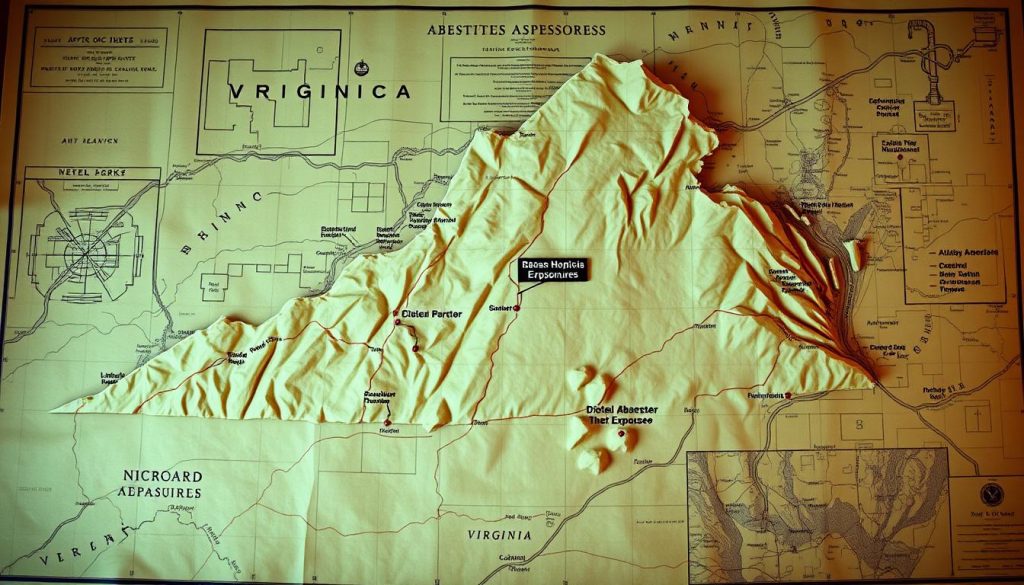
Let’s explore Virginia’s industrial past on a road trip. It’s a place where dreams and dangers meet. Imagine Google Maps for harmful substances, but we’re tracking asbestos instead of traffic.
Our adventure starts in 1894 with anthophyllite mining in the Sall Mountain area. The state’s geology made it a high-risk zone. This risk is felt by communities today.
This isn’t just looking back. We’re uncovering how old dangers affect people now. Workplaces, homes, and neighborhoods in Virginia are impacted. The state’s rules only tell part of the story.
Think of this as a detailed tour of hidden dangers. It connects industrial history with today’s reality.
Understanding Health Risks: Mesothelioma and Other Illnesses
Imagine a villain so stealthy it operates undetected for decades before striking. That’s asbestos – nature’s perfect biological weapon disguised as industrial miracle material. These microscopic fibers don’t just irritate your lungs; they wage a silent war against your cellular integrity.
The statistics read like something from a dystopian novel: 400+ deaths in Libby, Montana alone. Over 1,750 diagnoses nationwide. The EPA has declared multiple health emergencies, yet most Americans remain unaware of these exposure risks lurking in plain sight.
Let’s talk about the elephant in the room: mesothelioma. This cancer doesn’t play fair. It’s the biological equivalent of a sleeper agent – symptoms can take 20-50 years to manifest. By then, the damage is often irreversible.
Why is asbestos so devastating? Three cruel ironies:
- Durability becomes danger: The same toughness that made it perfect for insulation makes it impossible for your body to break down
- Heat resistance turns to biological betrayal: Your body’s defense mechanisms can’t neutralize what won’t degrade
- Microscopic size enables maximum damage: These fibers bypass natural filters to embed deep in lung tissue
The national numbers are sobering: 12,000-15,000 American deaths annually from asbestos-related diseases. Virginia communities have borne their share of this burden, with legacy industrial sites continuing to impact public health.
Beyond mesothelioma, asbestos exposure risks include:
- Lung cancer (even in non-smokers)
- Asbestosis – progressive scarring of lung tissue
- Pleural thickening – reducing lung capacity
What makes this particular? The latency period. You could have been exposed in your 20s and only discover the consequences at retirement. It’s like signing a biological contract with terms that don’t become clear for half a century.
The real tragedy? Most victims had no idea they were playing Russian roulette with their health. Construction workers, shipyard employees, even teachers in old buildings – all facing similar exposure risks without proper warning.
This isn’t just medical history; it’s an ongoing public health crisis. Understanding these mechanisms isn’t about fear-mongering – it’s about recognizing that some industrial legacies keep collecting interest long after the factories close.
Legal Remedies: Filing an Asbestos Claim
Imagine playing a game where you chase down big companies that hid health risks for years. It’s like a game of corporate whack-a-mole, but with real consequences. The tools you use are called asbestos legal claims.
In Virginia, asbestos cases are like a maze. The maze is filled with legal rules and changes often. The main rule is you have two years from when you find out you have an asbestos-related illness.
Asbestos trust funds are like a lifeline for victims. When companies went bankrupt, they set up these funds. Today, there’s $30 billion in these funds across the country. It’s like finding out the bad guys left you money as a way to say sorry.
To win your case, you need to know three main ways to file:
- Trust fund claims: Against bankrupt companies’ funds
- Litigation: Against companies that are not bankrupt
- VA claims: For military-related cases
Virginia cases show both hope and challenges. One worker got $8.5 million after proving his case. But another family’s case was delayed for three years. The system can work, but it’s not always fair.
The key to winning is to have good evidence. You need medical records, work history, and proof of asbestos use. It’s like building a case against someone who knew they were selling dangerous products.
Working with Virginia asbestos attorneys is very important. They know which companies were involved and which funds are available. It’s like solving a mystery to get the compensation you deserve.
This isn’t just about money. It’s about making companies pay for their actions. It’s about covering medical costs, lost wages, and recognizing the human cost of their greed. The legal process may be slow, but it’s a way for victims to fight back.
Remember, these claims are not just about winning money. They are about justice for those harmed by corporate greed. In Virginia, these claims are very much alive and ongoing.
Support and Resources for Affected Families
Asbestos brings more than just a diagnosis. It shakes your finances and your emotional well-being. It’s like an unwanted guest who messes up your home and makes you pay for the cleanup.
Finding your way through this tough time needs more than a map. You need a whole survival kit. Let’s look at the support systems for Virginia families.
The cost of asbestos-related illnesses is huge. It feels like trying to save the Titanic with a tiny cup. But, sometimes, the system works.
Virginia has Medicaid programs for asbestos-related conditions. The challenge is knowing where to start and what to bring.
| Program | Coverage Details | Eligibility Requirements | Application Timeline |
|---|---|---|---|
| Virginia Medicaid Asbestos Care | Specialized treatments, diagnostic tests, prescribed medications | VA residency, confirmed diagnosis, income below 200% FPL | 30-45 days approval |
| Veterans Asbestos Health Program | Complete care package including experimental treatments | Military service history, asbestos exposure documentation | 60-90 days processing |
| Libby Cleanup Legacy Fund | Home remediation, temporary relocation costs | Residence in affected areas, medical confirmation | 4-6 months review |
| Non-Profit Emergency Grants | Immediate living expenses, travel for treatment | Diagnosis proof, financial hardship demonstration | 2-3 weeks emergency processing |
Medical Care Navigation
Finding a doctor for mesothelioma is hard. It’s like searching for a needle in a huge haystack. Virginia has great centers, but finding them is tricky.
The University of Virginia Medical Center has a top thoracic oncology program. VCU Health offers full care with short wait times.
Veteran-Specific Resources
For military families, the VA can be both a challenge and a help. It’s ironic that the VA, which might have exposed you, can also treat you.
VA hospitals in Richmond and Hampton offer asbestos care. But, getting through the claims process is tough.
Non-Profit and Community Support
Non-profits are a big help when the system moves slow. Groups like the Mesothelioma Applied Research Foundation offer real support. They help with legal advice and even dog walking.
These organizations provide a lot of help. They connect you with legal experts and offer volunteers. This way, you don’t have to worry about everyday tasks when you’re fighting for your life.
The EPA’s Libby cleanup shows that big efforts can happen. It’s a reminder that help is possible, even if it takes time.
Remember, you need to advocate for yourself. Keep detailed records and follow up on everything. This way, you’ll get the help you need.
In the world of asbestos, being proactive gets you noticed. It’s not just about asking for help. It’s about making sure you get it.
Historical Context and Industrial Impact
Imagine a time when workers wore asbestos-lined gloves, unaware of the danger. Virginia’s industrial scene was a hotbed for asbestos exposure. With 60 mines in the eastern US, factories, shipyards, and construction sites were hungry for the toxic material.
Today, 1.3 million American workers face asbestos exposure every year, OSHA reports. Workers in Virginia were at high risk, breathing in harmful dust. Companies knew it was toxic but didn’t act.
This isn’t just about the past. It’s about seeing how today’s industries ignore workplace safety. The same problems that hurt workers then are happening now with new dangers.
We’re not just looking back. We’re finding a pattern of corporate neglect. The solution? We need real workplace safety rules, not just empty promises.
Sports Facilities and Community Safety Initiatives
Beneath the cheering crowds and victory laps lies a silent threat in many Virginia communities. Our playgrounds and sports facilities—those supposed safe havens—sometimes host an unwanted guest: asbestos contamination. It’s the environmental hazard nobody ordered but many communities received through historical industrial neglect.
The EPA’s findings hit like a poorly thrown fastball: over 8,500 schools nationwide contain friable asbestos. That’s millions of children potentially exposed in buildings meant to be shelters, not hazards. The irony isn’t lost on anyone—we worry about concussions on the field while ignoring what’s lurking beneath the turf.
Virginia’s approach combines sober assessment with proactive measures. Community cleanup initiatives now prioritize soil testing before any field renovation. Schools implement strict protocols during renovations, because safety should always beat speed. It’s not scare-mongering—it’s smart community management.
Consider how different community spaces compare for asbestos risks:
| Facility Type | Common Risk Factors | Typical Exposure Pathways | Virginia Safety Initiatives |
|---|---|---|---|
| School Gymnasiums | Aging insulation, floor tiles | Airborne fibers during renovations | Mandatory pre-renovation audits |
| Public Playgrounds | Contaminated soil from past industry | Soil disturbance during play | Soil testing programs |
| Community Centers | Pipe insulation, ceiling materials | Deterioration over time | Regular maintenance inspections |
| Sports Fields | Historical industrial site usage | Ground disturbance during construction | Land use history reviews |
These initiatives represent a fundamental shift from reaction to prevention. Virginia’s asbestos abatement projects now follow stricter protocols than federal requirements. Communities demand—and receive—proper handling of this persistent environmental hazard.
The game has changed. We’re no longer just scoring points on the field—we’re protecting the very ground we play on. That’s a victory worth cheering for.
The Role of Advocacy Groups in Spreading Awareness
Forget what you learned in civics class. The real change-makers are the angry citizens who fight against asbestos. They turn their homes into war rooms for change.
These groups start as support groups and grow into powerful lobbying forces. They use personal stories and science to push for policy changes. Even the toughest politicians can’t ignore them.
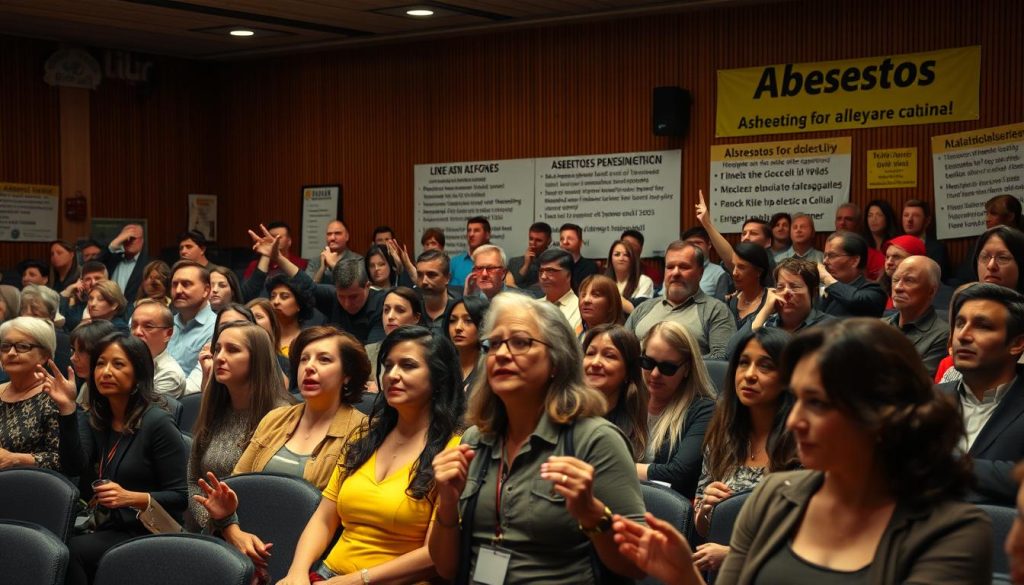
In Virginia, what began as family talks turned into a movement. These groups have:
- Pushed for stronger workplace safety regulations
- Funded independent asbestos exposure research
- Created community education programs that actually work
- Lobbied for better healthcare access for victims
These groups are experts at making asbestos awareness relatable. They know that stories, not just numbers, can change minds. And they have plenty of stories to share.
The Asbestos Disease Awareness Organization is a prime example. Their annual events mix science with personal stories, creating a powerful impact.
What makes these groups so effective? They combine science with personal stories. It’s hard to ignore someone when you’ve heard their story and seen their X-rays.
Their impact goes beyond laws and regulations. They’ve changed how we see asbestos. It’s now linked to corporate wrongdoings and human suffering. This is how you change the world from home.
Preventative Measures for Present and Future
Imagine a world where stopping asbestos isn’t just fixing problems but creating a safe future. We’re getting closer to that dream.
Today, asbestos prevention has moved from simple masks to advanced tech. We now have containment systems that could even hold off a Marvel villain.
The HEPA filter is at the core of this tech leap. These filters are not your grandma’s vacuum filters. They catch particles smaller than most bacteria.
In Virginia, we mix federal OSHA requirements with state rules. The state requires strict licensing for professionals. But is it enough?
Here’s what you need to know about protective equipment:
- Level C protection: Full-face respirators with HEPA cartridges
- Disposable coveralls that resemble hazmat chic
- Double-bagging systems for contaminated materials
- Decontamination showers that would make a car wash jealous
The EPA regulations set the stage, but the real work happens in the field. We now have advanced monitoring equipment like real-time air samplers.
Our containment systems use plastic barriers and machines that clean the air like hospitals. It’s all about keeping workers safe.
The future of asbestos prevention is even brighter. We’re talking about smart sensors and robots that do the dangerous work. It’s safer for everyone.
Virginia’s licensing ensures professionals are well-trained. But tech moves fast. Are our rules keeping up?
Next, we’ll see community-wide monitoring equipment. Imagine sensors that warn us of dangers early. It’s not far off.
The tech for protective equipment keeps getting better. We now have smart respirators and coveralls that keep you cool. Worker safety has never been more advanced.
At the end, asbestos prevention is about more than rules and gear. It’s about putting people’s health first. Some risks are just not worth it.
The Ongoing Fight for Safer Workplaces
Asbestos dangers are not just a thing of the past. They are a never-ending nightmare. The fight for safe workplaces is like a game of whack-a-mole. Every time we solve one problem, another one appears.
Today, we face a new challenge. Chloralkali plants use raw asbestos for chlorine production. They choose profits over people’s health. The situation is both sad and shocking.
In Texas and Louisiana, plants dump millions of pounds of asbestos annually into landfills. Workers handle this dangerous material every day. They often have little protection. This is because safer options are too expensive.
Corporate greed keeps this going. Companies are slow to change, preferring to risk everything. Politicians help by saying rules would harm jobs.
We’ve known about safer alternatives for decades. Yet, we keep using asbestos because it’s cheaper. The delay is all about money, not science.
Activists and groups fight for safety, but they face strong opposition. They are accused of wanting to kill jobs. This is a clever way to hide the truth.
Workers in Virginia are caught in this fight. They don’t know the dangers they face. It’s ironic and deadly.
The goal is to keep pushing for safety. We need to raise awareness and demand change. Workplace safety should be a basic right, not something to negotiate.
FAQ: Legal and Health Questions Answered
Let’s tackle the tough questions about asbestos exposure. Knowledge is power, which is key when dealing with serious health issues like mesothelioma.
How long after exposure might symptoms appear? Asbestos-related diseases often have long latency periods. Symptoms may not show for 20 to 50 years. This delay makes early detection challenging but highlights the importance of regular health check-ups if you’ve been exposed.
What’s Virginia’s statute of limitations for asbestos claims? In Virginia, you typically have two years from the date of diagnosis to file a personal injury claim. For wrongful death cases, it’s two years from the date of death. Don’t wait—time is of the essence.
Can you sue if exposure happened decades ago? Yes, you can. Many successful claims are filed long after exposure occurred. The key is linking your illness to past asbestos contact, often through work history or environmental factors.
What legal options exist for affected families? Victims can pursue compensation through lawsuits, trust funds, or VA benefits. Each path has specific requirements, so consulting a specialized attorney is key.
Are there resources for medical and emotional support? Organizations like the Mesothelioma Applied Research Foundation offer guidance. Support groups provide community and comfort during difficult times.
Remember, this information empowers you to ask the right questions and seek appropriate help. When it comes to asbestos, there’s no such thing as a stupid question—only unanswered ones.