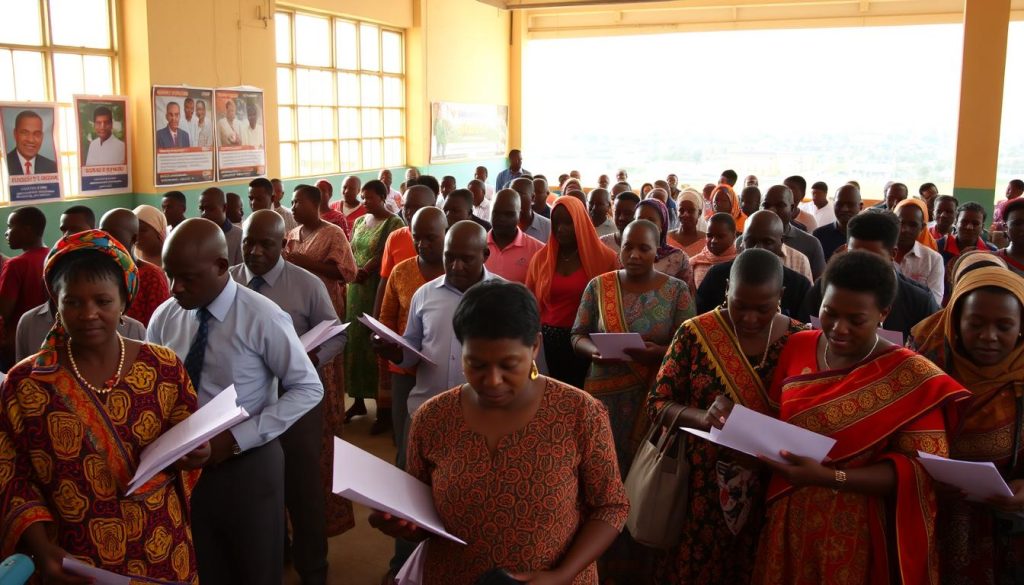
Welcome to a place where politics has been the same for decades, but things are getting unstable. Imagine a country with a low human development ranking but lots of oil money. It’s like winning the lottery but not knowing how to use the prize.
Here, 67% of people live in poverty, and 20% are unemployed. You’d think there would be a lot of political drama. But instead, everything is very controlled, with the same leader always in charge.
The government hires almost a quarter of the people. This makes it hard for citizens to choose their leaders freely. As we look into this unique political scene, remember: in this part of Africa, the government always comes out on top, even when it’s failing.
Mapping Presidential Campaigns: Key Players and Strategies
If African presidential campaigns were a Monopoly game, Equatorial Guinea would have all hotels on Boardwalk with permanently fixed dice. The opposition candidates face what I’d call the roach motel dilemma – they check in but don’t check out of the political arena.
Consider these sobering numbers: only 1 in 6 major African elections results in actual power transfer. Six of the world’s ten longest-serving presidents call Africa home. This isn’t political longevity – it’s political entrenchment.
The playbook for maintaining power reads like a dictator’s shopping list. First, change the constitution when term limits become inconvenient. Second, exclude serious challengers through legal technicalities. Third, make sure certain voters can’t access polling stations.
The fourth strategy involves weakening election watchdogs until they’re about as effective as chocolate teapots. The final move? Cultivate loyalty through clientelism – what ordinary people call “keeping the lights on for your friends.”
- Constitutional manipulation to extend term limits
- Candidate exclusion through legal technicalities
- Voter suppression in opposition strongholds
- Watchdog neutering through legislation
- Clientelism networks that trade favors for votes
This creates what analysts call competitive authoritarianism – elections happen, but the outcome feels more predetermined than a season finale of your favorite drama series. The opposition participates knowing the deck is stacked, while the incumbent plays with marked cards.
In this landscape, presidential campaigns become less about convincing voters and more about maintaining control systems. It’s the political equivalent of a magic show where everyone knows the tricks but applauds because the alternative might involve disappearing elephants.
The Role of Sports in Mobilizing Voters
In Equatorial Guinea, stadiums are now key places for getting people to vote. The government uses electoral athletics to make voting seem like a game. Everyone knows the outcome before it even starts.
With 56% of people under 25, you might think digital campaigns would be big. But instead, rallies feel like a fixed game. The focus is on cheering, not real talk.
Most people live in cities, making rallies easy to organize. This setup is perfect for political shows.
Youth unemployment adds to the mix. When jobs are scarce, rallies become a way to stand out. The reward? Maybe not losing your scholarship or getting a government job.
| Sporting Events | Political Rallies | Youth Participation Rate |
|---|---|---|
| National Football Matches | Presidential Appearances | 92% attendance expected |
| School Athletics Competitions | Youth Wing Mobilizations | 88% participation required |
| Community Sports Festivals | Neighborhood Campaign Events | 75% voluntary attendance |
This isn’t real sports and voter engagement. It’s more like a show. Political teams have learned from American efforts to get people to vote. They focus on showing power, not winning hearts.
But there’s more to it than meets the eye. Party teams work hard to outdo each other. They turn voting into a competition, where numbers matter more than opinions.
Despite the setup, real connections can happen. Sports terms like teams and victories shape political talk. The cheers, even if planned, influence how people think about politics.
International Watchdogs and Democratic Legitimacy
Watching international election observers in places like Equatorial Guinea is like seeing art critics judge a paint-by-numbers. They come with clipboards and credentials, checking if elections really make a difference.
The numbers are huge. The EU gave €400 million for electoral help worldwide in five years. The US spends $2-3 billion yearly on promoting good governance. This makes democracy promotion a big business.
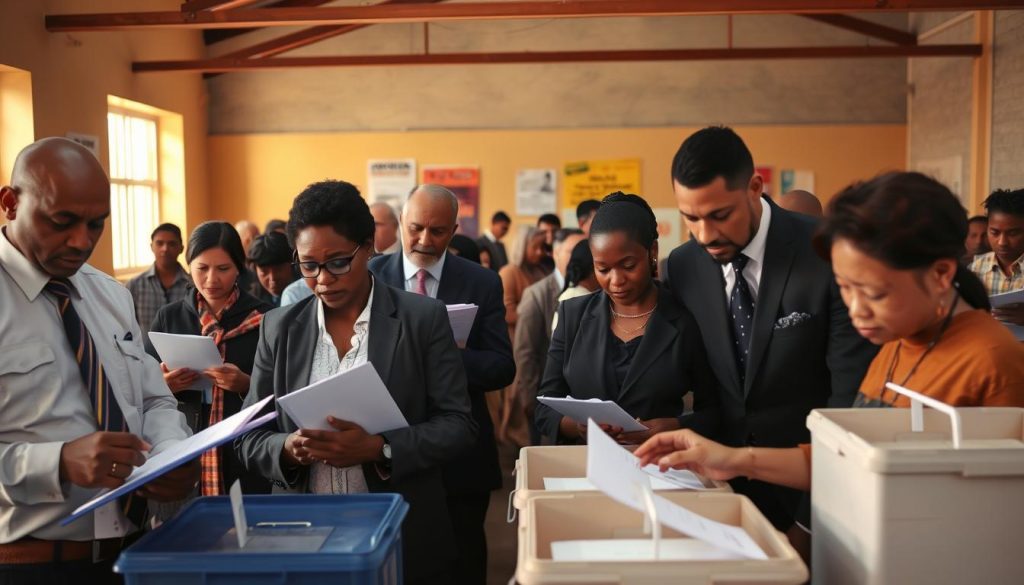
Regional groups have gotten better at tracking elections. The African Union and ECOWAS have shown they can handle political crises. They’re like bringing a thermometer to a volcano – they measure the heat, but can’t cool it down.
These missions face a big problem. They can point out issues, but the real power stays the same. Their reports might talk about voting problems or media access, but the politics don’t change.
The role of international observers is interesting. Governments put on a show for them, but keep control. It’s like democracy as a play, with observers as critics who can’t change the story.
But the show keeps going. The election observation field grows, creating jobs for many. It’s a strange mix – authoritarian regimes get a stamp of approval, and democracies feel like they’re doing something good.
African leaders find new ways to dodge regional rules. They’ve made election observation a political art, where everyone plays a part but the story never changes.
Youth Participation: From Sports Teams to Polling Stations
Looking for real youth involvement in Equatorial Guinea’s politics? You might as well search for a democratic paradise in The Hunger Games arena. The idea of moving from sports to voting seems more like a trick than a real path.
Young people at political events often show up for a reason other than belief. With youth unemployment at 20%, attending rallies can be a way to survive. The government’s approach to sports and voter engagement seems more like job help with fancy uniforms.
Gender issues add to the problem. Only 15% of civil service jobs go to women, making “inclusive democracy” sound like a joke. Also, just 5% of workers hold top positions, with the military dominating even more.
The journey from sports to politics is like corporate team-building. You get the uniform and learn the chants, but you don’t make the decisions. Political involvement is like joining the company softball team – it looks good but doesn’t really count.
| Demographic Metric | Youth Population | General Population | Disparity Gap |
|---|---|---|---|
| Unemployment Rate | 20% | 8.5% | 11.5% |
| Female Civil Service Representation | 12% | 15% | 3% |
| Management/Director Positions | 2% | 5% | 3% |
| Political Leadership Roles | 1.5% | 4.8% | 3.3% |
This isn’t real sports and voter engagement. It’s just a show with sports gear. The system controls youth energy, turning it into just a show of support. Young activists are like extras in a movie, wearing the right clothes but without real lines.
The real game isn’t in sports or voting. It’s about keeping up the illusion of youth involvement while controlling its true impact. The score? The status quo wins, with democracy losing.
The Media’s Role in Election Cycles
In Equatorial Guinea, the media doesn’t just report the news. It acts as a key player in the election process. Imagine a scene where everyone follows a script, but no one can change it.
The 2019 V-Dem report highlighted media manipulation as a major threat to democracy. State-controlled media outlets often serve as tools for the government. This makes journalism look more like propaganda, but with better quality.
Televised debates in these situations are like political theater. Candidates get questions that have been approved beforehand. Moderators act more like stagehands than journalists. It’s like watching reality TV, but with no real competition.
Remember when the DRC shut down media and arrested journalists during elections? Equatorial Guinea uses a more subtle approach. Instead of arresting reporters, they make them seem irrelevant.
Media monitoring missions often arrive with high hopes but leave with lower expectations. International observers say watching the process is like reviewing a restaurant with a great menu but only one dish.
The real tragedy is not the lack of media freedom. It’s that citizens have learned to navigate this distorted landscape. They’ve become skilled at reading between the lines and understanding what’s not said.
What happens when media becomes an extension of the state? You get election coverage that focuses on the process, ignoring the substance. It’s like praising the wrapping paper while ignoring the empty box inside.
Election Security and the Prevention of Violence
Imagine election security as a shield against chaos, not just a barrier. It’s like a bouncer at a club, deciding who gets kicked out quietly. This is what experts call “preventive stabilization,” or keeping the peace without anyone noticing.
In other African nations, things are different. The Democratic Republic of Congo saw electoral violence in places like Kalemie and Lubumbashi. But Equatorial Guinea uses a different kind of violence. They freeze bank accounts and lose business licenses instead of breaking bones.
This creates a strange kind of political stability. It’s like living in a building that might not fall but wouldn’t pass inspection. The government controls tension, deciding who can shout and who must leave quietly.
Intimidation in Equatorial Guinea is subtle. Your cousin might get moved to a remote office, or your business audited during election time. These actions keep everyone in line without causing a scene.
The beauty of this system is its ability to deny any wrongdoing. In the DRC, you see bullet casings and burned polling stations. But in Equatorial Guinea, it’s just paperwork delays and “administrative reassignments.” Both keep the outcome in control, but one leaves fewer scars.
This creates a feeling of stability through constant anxiety. You might not get shot for protesting, but your daughter’s scholarship could be in danger. It’s like election security as a form of psychological theater, where real violence is in whispers and red tape.
The ultimate goal? A political stability so strong that people police themselves. The real power isn’t the guns, but the stamps and transfer orders. That’s what I call preventive stabilization.
Civil Society: Grassroots Movements and Athletic Clubs
Athletic clubs in Equatorial Guinea are like secret meeting places. They seem harmless but hide deeper meanings. Football and running clubs are perfect for hiding political talks.
The government lets these clubs exist, like a parent playing along with kids. But, if someone tries to change the rules, they face trouble.
Donor support is a rare chance to promote democracy. International groups help through sports and culture. It’s a way to build skills, but only in a controlled way.
In the DRC, the Catholic Church used 40,000 observers to monitor votes. This shows what’s possible in African governance. But in Equatorial Guinea, even churches are watched closely.
Grassroots movements face a lot of danger. Authorities can change what’s allowed at any time. This makes civil society seem more like plants in pots, allowed to grow but only in certain ways.
The big challenge in African governance is clear: building democracy in a place where gatherings are seen as threats. Athletic clubs are a way to teach skills without raising alarms. They learn democracy through sports.
| Civil Society Model | Equatorial Guinea Approach | DRC Catholic Church Model | Impact on Democratic Development |
|---|---|---|---|
| Athletic Clubs as Cover | Tolerated with supervision | Not primary approach | Builds basic organizational skills |
| International Donor Support | Channeled through approved activities | Direct election support | Varies from subtle to direct impact |
| Religious Institution Role | Heavily monitored | Active monitoring leadership | 40,000 observers vs. limited local capacity |
| Government Tolerance Level | Training wheels approach | Independent operation | Determines how far civil society can reach |
Policy Recommendations for Election Integrity
When democracy promotion meets Equatorial Guinea’s politics, it’s like teaching chess to someone who thinks they’ve won. The usual steps – observer missions, technical help, and training – are like using a smartphone in a knife fight. Sometimes, the best policy is to admit that your efforts are mostly for show.
The latest research on election integrity shows we need to slow down. Instead of trying to build Rome in a day, focus on small improvements. This means working with what’s already there, not against it.
Technical fixes have their role. Things like biometric voter registration and clear results systems can help a bit. They’re like adding security cameras to a casino – they won’t change the game, but they might make things slightly better.
Local groups and regional organizations often do more than big international players. They know the local scene better and face less pushback. Supporting them is like having a local guide, not relying on Google Maps in an unknown place.
| Ideal Recommendation | Realistic Application | Probable Outcome |
|---|---|---|
| Comprehensive electoral reform | Incremental technical improvements | Marginally better transparency |
| Full opposition participation | Limited opposition access | Controlled political space |
| International observer missions | Regional organization monitoring | Selective legitimacy |
| Civil society empowerment | Athletic club mobilization | Grassroots engagement |
The most honest way to promote democracy here is like couples therapy where one partner isn’t there. You work with what you have, celebrate small wins, and remember that flawed elections are better than none. Progress might look more like dusting furniture while the bull’s distracted.
Anticipating the Poll Results: What’s Next for Governance?
Trying to guess who will win in Equatorial Guinea’s election is like guessing the next twist in a telenovela. You know the family will stay in power, but with new drama. The real question is how they’ll spin the win for the world.
Numbers show a harsh truth: in most African elections, the winner stays in power. It’s not about democracy; it’s about survival. Leaders risk jail or worse if they lose.
Real change is hard to find in a system that feels like a family business. The real shift is between family members, not parties. We’ll see more talk of progress, but the power stays the same. The real question is when and how change will come.