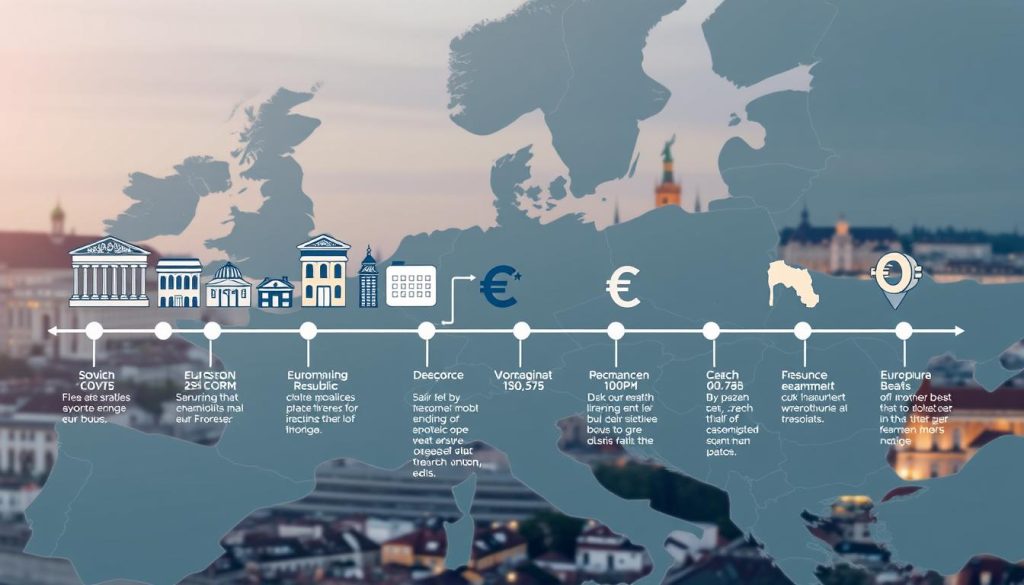
Remember that friend who’s always “working on themselves” while everyone else couples up? Meet the Czech koruna – Europe’s most committed bachelor currency.
Our story starts with the 1992 Maastricht Treaty. It was a big step towards European Union economy integration. The treaty set strict rules, making other agreements seem easy.
When the Czechs joined the EU in 2004, they made a promise. “We’ll adopt the euro someday.” It’s like saying “we should totally hang out sometime.”
The euro first appeared as “book money” in 1999. It became real money in 2002. Despite financial crises and big changes, the koruna stayed single. Twenty other EU countries joined the euro, though.
This isn’t just about money. It’s Europe’s longest love story. And the story is far from over.
Decision-Making Dynamics: Setting the Date
Setting the euro adoption date in the Czech Republic is like organizing a flash mob. Everyone admires the plan but no one acts on it. The 2007 Updated Euro Area Accession Strategy is like a recipe everyone loves but nobody cooks.
The Maastricht criteria are at the heart of this issue. They act as the bouncers at the eurozone’s door. They check for:
- Inflation rates that can’t party too hard
- Government deficits that know when to call it a night
- Debt levels that maintain perfect composure
The Czech National Bank’s 2025 survey shows our economy is ready for the euro. But our political will is stuck. It’s like having a perfect orchestra with no conductor.
This isn’t just about numbers. It’s about monetary policy as a team sport. Everyone wants to be captain but nobody practices. The decision-making table has more stakeholders than a royal wedding.
The Czech Republic is in a limbo state. It’s like being in the EU group chat but not fully committed. This creates tension between national sovereignty and financial integration.
European integration scholars say the Czech situation is complex. The economy is ready, but politics moves at its own pace. Sometimes it’s slow, sometimes it’s fast.
The monetary policy and politics are closely tied. It’s not just about numbers. It’s about who benefits or loses from the timing. The 2025 survey shows analysts see political gamesmanship as the main issue.
The journey to full financial integration is like a dance. Everyone knows the steps but can’t agree on the music. The Czech government’s plans are clear, but the date is set by political winds.
Economic Pros and Cons of Joining the Eurozone
Joining the eurozone is like switching from a bike to a high-speed train. It’s faster and smoother, but you lose control. The Czech National Bank’s analysis shows this tradeoff clearly.
Businesses gain three big benefits. First, they no longer worry about currency changes. Companies trading with Germany or France don’t need to guess currency swings.
Second, transaction costs go down fast. Bank fees for converting koruna to euros disappear. The costs of currency hedging also vanish.
Third, prices become easy to compare. Czech shoppers can see prices across borders without needing a math degree. That French wine now costs the same in euros, no matter the koruna price.

But there are downsides. Losing control over money is like giving up your personal thermostat. You get the European Central Bank’s temperature for everyone.
This is a problem when the Czech economy doesn’t match the eurozone’s. The eurozone’s interest rate might not fit the Czech economy well. It’s like wearing a borrowed suit that’s too tight or too loose.
Real exchange rate appreciation is another issue. Normally, this comes from currency strength. But after joining the euro, it comes from higher inflation. It’s like choosing between dieting or wearing bigger pants.
Switching to the euro isn’t free. Businesses face costs for updating systems, changing prices, and training staff. It’s like preparing for Y2K, but for currency.
| Aspect | Pro Argument | Con Argument | Net Impact |
|---|---|---|---|
| Exchange Rates | Eliminates currency risk for businesses | Loses adjustment mechanism for economic shocks | Mixed – stability vs flexibility |
| Transaction Costs | Saves 1-2% on cross-border payments | One-time conversion expenses for businesses | Positive long-term |
| Monetary Policy | Aligns with European Central Bank expertise | Loses ability to set interest rates for local conditions | Negative for policy independence |
| Price Transparency | Easy cross-border price comparisons | Potential for inflationary price rounding | Mostly positive |
| Economic Reforms | Forces structural improvements | Requires painful austerity measures | Depends on implementation |
These economic reforms test Czech financial maturity. The pros offer efficiency gains. The cons require careful thought about giving up control.
The euro decision is more than just about money. It’s about choosing between control and convenience, independence and integration. Like in economics, there’s no free lunch – just different choices with different costs.
Public Opinion and Political Debates
Economics is the engine for adopting the euro, but Czech politics is the driver taking wrong turns. The 2025 survey by the Czech National Bank shows a “highly politicized” environment. This means no one agrees on anything important.
This political gridlock is a big challenge for the sports business in Czech Republic. Currency stability is key for player contracts and ticket prices. It’s like explaining to football fans why their beer is more expensive, just because of currency changes.
The biggest hurdle is the disconnect between what people feel and what the numbers say. Studies show people feel price increases more than they actually are. It’s like thinking your haircut looks bad when you leave the salon, but it’s fine later.
For the sports business in Czech Republic, this gap can be tough. Stadium concession stands might face price complaints, even if prices haven’t really changed. Player contracts in euros can confuse fans used to crown-based salaries.
The political debate is like a chess match with different rules. Some politicians delay euro adoption until after the next election. Others are too rigid, even for sports fans.
This lack of agreement keeps the Czech Republic in a “should we or shouldn’t we” loop. It’s like Hamlet’s indecision, but worse. The uncertainty affects sports organizations planning for the future.
The debate over euro adoption is more than about money. It’s about Czech identity and how they see themselves in Europe.
For Americans, this might remind them of debating metric conversion. It’s technically smart but emotionally and politically tricky.
The ongoing debates affect business operations and planning. Without clear direction, the sports business in Czech Republic must deal with uncertainty. They need to keep fans engaged and financially stable.
This situation is odd. Economic facts and political talk are in different worlds. Data shows one thing, but public opinion and politics tell another.
As the debate goes on, one thing is clear. The decision on euro adoption in the Czech Republic will be influenced by psychology, politics, economics, and statistics. Sports businesses will have to adjust to whatever happens next.
How Sports Businesses May Be Affected by Euro Adoption
Imagine running a sports business where your biggest opponent isn’t the rival team, but currency fluctuations. For Czech sports enterprises, the euro debate is more than just economic policy. It’s about whether to play defense or offense in the European arena.
The elimination of exchange rate risk would change how Czech teams operate internationally. No more watching transfer fees fluctuate like a volatile stock market. That million-euro striker? His price stays fixed, regardless of koruna mood swings against the euro.

International player contracts become simpler than a perfectly executed set play. Agents and clubs can negotiate without currency conversion calculators on standby. The paperwork reduction alone might save more trees than a forest of hockey sticks.
Merchandise sales to eurozone tourists would smooth out like Zamboni-treated ice. No more conversion fees nibbling at profits like hungry fans at a concession stand. That Czech hockey jersey sold to German visitors? The profit margin stays consistent game after game.
But here’s where it gets interesting – price transparency forces Czech teams to compete directly with German or Austrian clubs. It’s the economic equivalent of moving from minor leagues to the big show. Ticket prices, merchandise costs, and sponsorship deals become instantly comparable across borders.
Sports hospitality businesses face both opportunity and challenge. Easier cross-border comparisons help attract international clients, but also create pressure to align pricing with eurozone competitors. That VIP box experience? Suddenly it’s measured against similar offerings in Munich or Vienna.
The conversion process itself resembles halftime reorganization – temporarily disruptive but potentially game-winning. Initial costs for updating systems, retraining staff, and adjusting pricing strategies might sting like a poorly timed penalty. The long-term benefits, though, could position Czech sports businesses for championship-level performance.
| Aspect | Current Situation (Koruna) | Potential Euro Impact | Business Implications |
|---|---|---|---|
| Player Transfers | Exchange rate uncertainty | Fixed euro pricing | Predictable budgeting |
| Merchandise Sales | Conversion fees applied | Direct euro transactions | Higher profit margins |
| Ticket Pricing | Local currency only | Eurozone comparability | Competitive pressure |
| Sponsorship Deals | Currency conversion clauses | Euro-denominated contracts | Simplified negotiations |
| European Competitions | Multiple currency handling | Single currency operations | Reduced administrative costs |
The Czech sports business landscape stands at a fascinating crossroads. Euro adoption could either level the playing field or reveal competitive gaps. One thing’s certain – the game is changing, and smart players are already studying the new rulebook.
For American investors eyeing European sports opportunities, the euro transition makes Czech sports businesses intriguing. The elimination of currency risk combined with EU integration creates a compelling investment proposition. It’s like finding a rookie with superstar talent at a reasonable draft position.
The final whistle hasn’t blown on this debate yet. But one can’t help but wonder: will Czech sports businesses embrace the euro as their new home currency, or will they prefer to keep playing in their familiar koruna arena? The answer might just determine who lifts the economic championship trophy.
European Integration: Case Studies and Comparisons
The Czech Republic’s euro journey shows interesting similarities with Europe’s varied approaches to monetary integration. Each EU member has its own political and economic reasons, making the European Union economy like a dance with different beats.
Croatia’s 2023 euro adoption is like a success story. They became eurozone members in under a decade, showing how political will can speed up technical steps. They treated convergence criteria as a checklist, not obstacles.
Sweden is like the cautious one. They agreed to join the euro but never started the two-year ERM II phase. It’s like saying you’re getting married but not setting a date yet.
Denmark got a special deal in the 1990s: a permanent opt-out. They keep their krone close to the euro but control their own money policy. It’s like having VIP access without paying the cover charge.
Poland and Hungary are like poker players waiting for the right moment. They keep their currencies while watching for the best time to join. Their strategy is all about careful risk management.
The ERM II is like Europe’s test for joining the euro. Countries must keep their exchange rates stable for two years. Some need to make adjustments, like couples in premarital counseling.
Studies show timing is key. Countries joining during calm times have smoother transitions than those joining during financial storms. It’s like learning to swim in a calm lake versus in a storm.
| Country | Euro Status | Adoption Date | Special Conditions |
|---|---|---|---|
| Croatia | Member | 2023 | Fast-tracked adoption |
| Sweden | Non-member | N/A | ERM II avoidance |
| Denmark | Opt-out | N/A | Permanent exemption |
| Poland | Non-member | Future | Wait-and-see approach |
| Hungary | Non-member | Future | Strategic delay |
These examples show there’s no one-size-fits-all approach to joining the euro. Each country’s path is shaped by its unique economic and political situation. Success in integration comes from preparation and timing, not just following rules.
The European Union economy keeps changing as countries deal with their monetary ties. Some rush in, while others take their time. This variety offers both challenges and chances for the Czech Republic as it considers joining the euro.
The Broader Economic Impact for Trade and Tourism
Imagine going to Europe’s economic party without worrying about money exchange. That’s what adopting the euro offers Czech businesses. It’s like getting a VIP pass to continental commerce. The Czech National Bank’s analysis shows real benefits.
For exporters, adopting the euro is like removing speed bumps on the Autobahn. No more worries about exchange rates means prices are predictable. Studies show that sharing a currency boosts international trade.
The tourism sector also gets a boost. Czech hotels become more appealing to eurozone travelers. No more hidden fees means prices are clear. Czech tourists abroad save money too.
But there’s a catch. Czech businesses face more direct competition from eurozone companies. It’s like removing Instagram filters – everything is clearer, sometimes too much.
Investment in the Czech Republic changes too. Foreign investors no longer worry about currency risks. This financial integration could attract more international capital. It could boost infrastructure and innovation.
| Aspect | With Czech Koruna | With Euro Adoption | Impact Level |
|---|---|---|---|
| Export Transactions | Exchange rate risk present | No currency risk | High positive |
| Tourist Spending | Conversion fees apply | No exchange costs | Medium positive |
| Price Transparency | Limited comparability | Full visibility | Mixed effects |
| Foreign Investment | Currency risk factored | Reduced risk premium | High positive |
| Business Competition | Buffer from currency differences | Direct price comparisons | Challenge/opportunity |
The Czech economy is at a crossroads. Financial integration could boost growth in trade and tourism. The benefits include lower costs, clearer prices, and better competition.
This isn’t just about money – it’s about connection. The euro is like the ultimate economic handshake with Europe’s biggest trading bloc. For businesses and tourists, this handshake could feel surprisingly comfortable once everyone gets used to it.
Looking Ahead: Challenges, Opportunities, and Global Perspectives
Looking into the future, we see a world where US trade issues and China’s rise affect the euro’s adoption. The CNB’s 2025 survey is like a thriller, with everyone adjusting their plans.
Europe is working on big projects like a banking union and better capital markets. It’s like a huge renovation project, but the plans keep changing.
The world changed after the Ukraine invasion, making European unity more urgent. A common threat speeds up the need for economic unity. This makes economic reforms essential, not just optional.
Meeting the Maastricht criteria is tough, but there are big benefits. Trade integration and lower costs are attractive. The Czech Republic’s choice will need to balance European dreams with practical needs.
This isn’t just about changing money. It’s about finding a place in a changing world. Monetary policy is both a defense and a strategy.