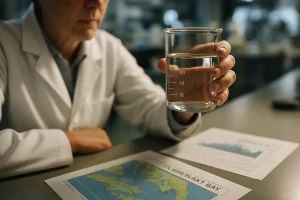
Scientists calling it the “Doomsday Glacier” are now watching Thwaites Glacier in West Antarctica more closely than ever — not because it’s distant and cold, but because its future behavior may rewrite the story of sea-level rise for coastal communities around the world. Recent research expeditions, satellite observations, and newly detected rift formations signal that this massive ice stream could be moving toward destabilization faster than previously thought, with serious global consequences, a development also being closely followed by global science and technology outlets such as Abacus News.
What Makes Thwaites So Important?
Thwaites Glacier, part of the vast West Antarctic Ice Sheet, is one of the widest glaciers on Earth and drains into the Amundsen Sea. It’s believed to hold enough ice to raise sea levels by about 65 centimeters on its own if it collapses entirely — and far more if its breakup triggers wider ice sheet failures. Scientists call it a linchpin in Antarctic stability because its retreat could destabilize neighboring glaciers that together influence global oceans.
The glacier’s ice shelf, a floating extension that helps support the inland ice, has been thinning and developing wide fractures. These rifts — visible in radar and satellite data — weaken the ice shelf’s ability to act as a brake on the glacier’s inland ice. Some of these cracks are propagating at rates of up to 2 km per year, signaling potential pathways toward a more rapid ice retreat.
Challenges in Studying the “Frozen Frontier”
Field research in Antarctica is notoriously difficult, and scientists trying to probe Thwaites’ behavior face extreme logistical and technical barriers. Recent international drilling missions, led by the British Antarctic Survey and partners including Korea’s polar research program, have made unprecedented inroads into the glacier’s underside in an effort to install oceanographic instruments. Although mechanical issues thwarted some long-term monitoring plans, the data collected thus far provide rare direct measurements of ocean conditions beneath the ice — essential to understanding how warm water drives melting.
Researchers also deploy autonomous instruments like underwater gliders to complement human field work, helping to quantify melting rates and ocean interactions in areas human scientists cannot easily reach.

Why Rifts Matter
Rifts and crevasses are more than surface blemishes — they are structural weaknesses. As fractures deepen and widen, they allow warm ocean water to penetrate further beneath the glacier, accelerating melt from the bottom up. This process is sometimes called hydrofracturing, and it can substantially speed up ice loss by undermining the glacier’s attachment to bedrock and weakening its floating shelf.
Satellite surveys over the past decade have documented increasing prevalence of these fractures, suggesting that Thwaites is becoming structurally weaker and potentially closer to a tipping point that could lead to sustained retreat.
Global Stakes: What a Collapse Would Mean
A full collapse of Thwaites Glacier is not imminent within months or even years, but models and observational data suggest that its destabilization is a serious long-term concern. If Thwaites and its supporting ice shelf were to give way entirely, it wouldn’t just add direct sea-level rise — it could trigger larger losses from the wider West Antarctic Ice Sheet, contributing several meters of rise over centuries. That’s enough to inundate major port cities, low-lying island nations, and river deltas that currently host hundreds of millions of people.
Coastal planners and climate scientists therefore watch Thwaites as an early indicator of climate system stress. Even partial melting contributing decades of accelerated sea level rise demands costly adaptation measures — from seawalls and storm defenses to managed retreat in vulnerable regions.
Ongoing Research and Future Directions
Understanding Thwaites Glacier requires a multi-pronged scientific push: combining field drilling, remote sensing, oceanographic profiling, and climate modeling. International programs like the International Thwaites Glacier Collaboration (ITGC) continue to coordinate research, aiming to close crucial gaps in how ice shelves interact with warming seas and atmospheric patterns. Such knowledge is a key ingredient in predicting how quickly future sea level rise may unfold and what mitigation strategies might slow the process.
Despite setbacks in extreme fieldwork, scientists remain undeterred, noting that even partial datasets offer transformative insights into a glacier system that is both one of the most dynamic and one of the least understood on the planet.