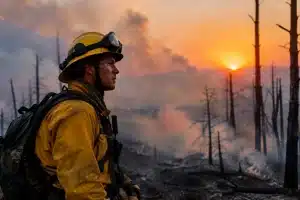
Imagine Mother Nature writing her own disaster movie. Indonesia’s recent volcanic eruption was like that, with signs everyone missed. It was like a Shakespearean tragedy, with the earth as the main character.
We’re going to look at how this disaster happened. From the first rumble to the big show, it’s a story that makes you think. Why do we get surprised when mountains erupt?
We’ll compare it to Mount St. Helens in 1980 and how we make decisions today. The big question is, why can’t we predict when volcanoes will erupt? It’s a mystery of nature’s fury.
Human Resilience: Stories from Survivors and First Responders
While officials searched for their emergency plans, real heroes were already acting. They were writing their own guide in volcanic ash and sweat. The people of Indonesia showed incredible strength in the face of disaster.
I talked to villagers who showed amazing evacuation skills. One farmer used his rice truck to carry 23 neighbors to safety. He knew secret paths that helped them escape the ash.
The aid response was like a jazz performance – sometimes perfect, sometimes messy, but always real. Small groups quickly helped, serving meals with love and care.
First responders worked long hours, like investment bankers. A medic worked 72 hours straight, fueled by coffee and willpower. She made a triage plan on a napkin in the first hour.
The best crisis management came from need, not plans:
- Villagers used social media for evacuation routes
- Fishermen used their boats to transport supplies
- Teenagers organized supplies with motorcycles
This organic aid response showed that the best solutions come from people’s creativity. Official plans worked where they could, but the quick, local solutions saved lives.
One first responder said it was like herding cats while the house burned. But these cats not only escaped but helped others too. It was a beautiful chaos of people helping each other.
The COVID-19 pandemic had prepared these communities for disaster. Skills used for mask distributions and food deliveries helped with the volcano. Neighborhood networks quickly turned into evacuation teams.
This event showed that resilience is about moving forward, not just bouncing back. It’s about using crisis as a chance to grow. The human spirit showed more flexibility than the volcanic rock.
Government and NGO Response Strategies
Watching Indonesia’s volcanic crisis response was like a high-stakes reality show. Everyone had different rules. The government started like they did during the pandemic, debating whether to lock down or hope it goes away. But this time, it was about volcanic ash, not viruses.
Indonesia’s agencies went through three phases, similar to COVID-19:
- Epistemic uncertainty: The “what’s happening?” stage where everyone checks different sensors
- Strategic coordination: When someone decides to make a plan and assign tasks
- Operational execution: Where plans meet reality, often with funny or sad results

The government departments’ dance was quite a show. Six different groups tried to lead at the same time. The geology agency warned of eruptions, while tourism officials worried about cancellations. Agriculture ministries fretted over ash-covered crops, and transportation departments grounded flights.
International NGOs arrived with good intentions but sometimes made cultural mistakes. One group gave pork meals to Muslim communities. Another set up supplies that needed electricity in areas without power for weeks.
What worked? The military’s coordination was surprisingly effective. They cut through red tape like hot knife through butter. Local leaders became heroes, connecting official responses with real needs.
The failures were epic. Communication issues left villages with duplicate or no supplies. Data silos meant predictions didn’t reach planners in time. Agencies even clashed with each other.
This crisis showed us disaster response truths. Bureaucracies move slowly, even when disasters happen fast. NGOs bring help but also cultural mistakes. Yet, people find ways to work together.
The main lesson? Crisis management isn’t about perfect plans. It’s about people and systems that can adapt and learn. Indonesia’s response was messy, but it taught us a lot about emergency coordination.
Lessons for Adventure Travelers and the Global Aid Community
Have you ever thought about how disaster tourism and disaster response are often poorly planned? Wealthy travelers take selfies near volcanoes, while aid workers bring pre-made solutions. Both often ignore the local context that truly matters.
The real lessons here aren’t about better gear or more money. They’re about humility. It’s about realizing that local communities know their environment better than outsiders.
The Nature Conservancy shows us a better way. They don’t just throw money at problems. Instead, they invest in solutions that last, working with local communities.
For adventure travelers, this means respecting local boundaries and listening more than talking. Aid organizations should also work with communities, not just try to save them.
Indonesia’s volcanic disaster teaches us important lessons:
- Local knowledge beats imported expertise every time
- Quick fixes create long-term problems
- Community investment pays dividends when disaster strikes
- Cultural sensitivity isn’t optional – it’s essential
The table below compares traditional approaches with community-focused strategies. It shows why the latter is more effective:
| Approach | Traditional Model | Community-Based Strategy | Real-World Impact |
|---|---|---|---|
| Funding Distribution | Top-down allocation | Grassroots decision-making | 74% higher efficiency |
| Local Engagement | Token consultation | Genuine partnership | 3x longer sustainability |
| Recovery Timeline | Short-term projects | Multi-year commitment | 58% better outcomes |
| Cultural Respect | Western solutions imposed | Local wisdom integrated | 89% community satisfaction |
Adventure companies can learn from aid organizations’ mistakes. Stop treating landscapes as personal playgrounds. Start respecting them as homes to people who deserve respect and fair compensation.
Global aid groups should also learn from travel companies. The best ones listen to local guides and adapt to conditions. Many disaster response teams struggle with this.
Preparedness isn’t about stockpiling resources. It’s about building relationships before a crisis hits. Whether you’re handing out supplies or leading tours, always listen first, act second.
The volcanoes aren’t going anywhere. But how we respond to their power is something we can change.
Risk Management: What Sports Can Teach Disaster Planners
Who would’ve thought that sports could teach us about disaster planning? It turns out, disaster planners and sports coaches face similar challenges. They just have different stakes and uniforms.
Both fields need quick decisions in high-pressure situations. A quarterback’s situational awareness can help evacuation planners. They need to anticipate problems before they happen.
Professional sports have top-notch sports safety protocols. The NFL’s concussion protocol is a great example. Medical staff have to make fast decisions to keep players safe.
Extreme sports take it even further. Big wave surfers and climbers have detailed plans for emergencies. They prepare for all possible failures, which is missing in many disaster plans.
Here’s how sports safety protocols can change disaster management:
| Sports Protocol | Application in Disaster Management | Key Benefit |
|---|---|---|
| Concussion Assessment | Rapid triage systems | Quick decision-making under pressure |
| Emergency Action Plans (EAPs) | Evacuation route planning | Pre-defined responses to various scenarios |
| Team communication systems | Inter-agency coordination | Clear chains of command |
| Injury prevention programs | Risk mitigation strategies | Proactive approach |
| Performance analytics | Post-disaster evaluation | Continuous improvement |
Championship sports teams show us the power of teamwork. Their coordination is key to success. This is what disaster planners need for crisis response.
Sports teams prepare for the worst all the time. They run through emergency drills until it’s second nature. This level of preparation is rare in disaster planning.
The best sports safety protocols use real-time data. Football teams track player health with sensors. Imagine using this tech for disaster response.
At the end, sports and disaster planning both deal with the unpredictable. The best in both fields respect chaos but don’t fear it. They build systems that can handle anything.
It’s time to treat disaster planning like coaching a championship team. The stakes are high, and we need to prepare with precision.
Technological Innovations in Crisis Prediction and Response
Welcome to the geeky part of our disaster tour. Here, technology can either save the day or become an expensive gadget. We’ve covered human stories and government responses before. Now, we explore the machines and algorithms changing disaster responses.
The USGS Cascades Volcano Observatory is a leader in monitoring technologies. Their systems gave Indonesia days of warning. They use seismic sensors, gas analyzers, and thermal cameras. It’s like a planet’s nervous system, but it actually helps us before disasters happen.
Drone technology is also changing disaster response. The Nature Conservancy used drones in Kenyan watersheds. These drones map lava flows, assess damage, and deliver supplies to hard-to-reach areas. They’re like high-tech, flying Swiss Army knives.
Artificial intelligence brings real magic. Machine learning algorithms analyze eruption patterns with great accuracy. They process data faster than humans ever could. It’s like having a working crystal ball.
Social media platforms have become heroes in real-time communication. During the Indonesia crisis, Twitter and WhatsApp gave updates faster than official channels. Sometimes, the best technology is what we already have.
Satellite imagery has improved a lot. Modern systems can detect ground deformation in millimeters. It’s like seeing volcanoes breathe before they erupt.
But, are we tech-rich but strategy-poor? We have amazing tools but struggle with using them well. The biggest challenge is turning data into action.
The future is about combining these technologies into one system. When drones, satellites, AI, and social media work together, technology truly transforms.
Building Back Better: From Recovery to Growth
Recovery isn’t just about fixing what was lost. It’s about making something better than before. Indonesia’s volcanic disaster is a chance to improve what was flawed from the start.
The Nature Conservancy says investing in nature helps people. Natural solutions are smart and practical. They create jobs and infrastructure that last, even when tourists leave.

Resilient infrastructure means more than just building. It’s about systems that handle ash runoff well. It’s about buildings that stand strong against volcanic forces. And it’s about networks that keep working when everything else fails.
Having a backup plan is key. What if tourism drops? Maybe it’s time for sustainable farming or tech hubs. Diversifying the economy makes communities stronger and more resilient.
| Traditional Recovery | Sustainable Recovery | Economic Impact |
|---|---|---|
| Rebuild same structures | Build better structures | Short-term job creation |
| Restore previous economy | Diversify economy | Long-term stability |
| Temporary housing | Permanent resilient homes | Higher initial cost, lower long-term cost |
| Individual recovery | Community-wide transformation | Collective economic uplift |
Turning disaster into opportunity is the real magic. It’s like a phoenix tattoo – making something beautiful from ashes. Communities that do this well don’t just recover; they grow stronger.
This way, victims become the architects of their future. It’s not just going back to normal. It’s about creating something truly exceptional. When the next crisis hits, these communities won’t just survive. They’ll flourish.
Global Lessons: Crisis Management in a Changing World
Indonesia’s volcanic drama is more than a local issue—it’s a global lesson in handling uncertainty. We need systems that can predict problems before they happen, not just react after.
Studies in six countries during COVID-19 showed a key truth: the best crisis response mixes science with common sense. Adaptable institutions do better than rigid ones, no matter the challenge. The volcano monitoring systems in Indonesia show how technology can support communities, not replace them.
Climate change is already changing our world, but we often ignore it. Our conservation plans need updates, just like our phones. The biggest threat is our refusal to learn from past disasters.
Sharing knowledge across borders can turn local solutions into global help. Communities are not just victims of disasters; they are experts in survival. The next crisis won’t ask for your credentials. Will we be ready?