
Europe’s late-June heatwave has moved from weather emergency to mortality event, with official surveillance showing 10,650 excess deaths during the week of June 22–28, 2026. More than 9,000 of those deaths were among people aged 65 and older, a sharp signal that extreme heat is hitting the continent’s most vulnerable residents first.
The figures, reported on July 13, 2026, came from EuroMOMO, the European mortality monitoring network supported by the European Centre for Disease Prevention and Control and the World Health Organization. They cover 27 European countries or subnational regions, and the count may still shift as delayed death registrations are added.
This is what climate change now looks like in public-health records. It is more than hotter afternoons. It is older adults dying at home, hospitals absorbing heat-related cardiac and respiratory emergencies, electric grids straining under cooling demand, schools closing, transport slowing, and cities discovering that housing built for past summers can become dangerous during the new ones.
For readers following climate health impacts, the June disaster shows why heat is becoming one of Europe’s most dangerous climate threats. It kills without the visible wreckage of floods or fires, yet the death count can exceed every other natural hazard on the continent.
The Week Europe’s Heat Became A Mass-Casualty Event
The late-June death count centers on week 26 of 2026, when the heatwave peaked across France, Spain, Britain, Belgium, the Netherlands, Germany, and other parts of western and central Europe. EuroMOMO’s pooled all-cause mortality estimate found a rare spike after weeks of relatively normal mortality. Lasse Vestergaard, chief physician at Denmark’s Statens Serum Institut, which hosts EuroMOMO, told Reuters that the excess was unusually high for this time of year and hard to explain by any factor other than extreme heat.
Excess deaths do not mean each death certificate lists heat as the direct cause. The method compares observed deaths with the number expected for the same period, then measures the gap. That approach matters for heat. Many deaths occur through heart attacks, strokes, kidney failure, respiratory distress, dehydration, or complications from existing disease. Heat is often the trigger that pushes a fragile body past recovery, not the neat label written on a medical form.
The EuroMOMO mortality data points to a continent-wide signal rather than a single-country tragedy. It remains a cautious number. Recent mortality weeks are often revised as late reports arrive, and national systems do not all process deaths at the same pace. The early signal is still large enough to change the scale of the debate.
| Heatwave Metric | Reported Figure Or Finding |
|---|---|
| Main mortality week | June 22–28, 2026 |
| Excess deaths reported | 10,650 across participating European countries or regions |
| Older adults affected | More than 9,000 deaths among people aged 65 and above |
| Data source | EuroMOMO pooled mortality surveillance |
| Countries or regions included | 27 European countries or subnational regions |
| Record signal | Western Europe recorded its warmest June on record |
Why Heat Deaths Are So Easy To Miss
Heat can be a silent disaster; the damage often appears inside ordinary medical categories. A person may die of heart disease, but the heat made the heart work harder. A patient may suffer kidney failure, but dehydration accelerated the crisis. A frail resident may collapse in an apartment that stayed hot through the night, with no dramatic scene outside.
Older adults face the highest risk. Aging reduces the body’s ability to regulate temperature. Certain medications affect sweating, hydration, blood pressure, and kidney function. Dementia can make it harder to recognize danger or drink enough water. Social isolation means warning signs may go unseen until it is too late.
The June pattern exposed another danger: warm nights. Daytime highs grab attention, but night temperatures decide whether the body gets a recovery period. If bedrooms remain hot after sunset, strain accumulates over several days. Fans may move air without cooling it. Thick walls may store heat. Urban neighborhoods can stay hotter than nearby rural areas through the night.
Heat deaths are often counted late, but they happen fast. The delay sits in the paperwork, not in the body.
Western Europe’s Hottest June Rewrites The Baseline
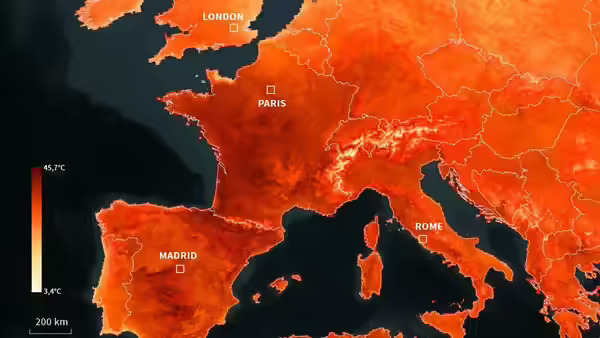
Copernicus data shows that June 2026 was the second-warmest June globally and Western Europe’s warmest June on record. The region’s average temperature reached 20.74°C, which was 3.05°C above the 1991–2020 average and above the previous record set in June 2025. The Copernicus climate bulletin reported intense heat across much of western and central Europe during the second half of June, with many June records and some all-time daily maximum records broken.
Those climate figures matter; they place the deaths in context. Europe did not experience a freak burst of summer discomfort. It experienced a heat event on top of a warmer climate baseline, across cities and regions with aging populations, limited cooling, older buildings, and health systems still working through staffing and budget pressure.
The World Meteorological Organization said western Europe had its hottest June on record and that Europe is among the fastest-warming continents. John Kennedy, WMO’s head of climate information, said Europe as a whole has warmed by about 2°C since the 1976 heatwave, a shift that has raised the floor under every new heat event.
Climate Attribution Turns The Death Toll Into Evidence
World Weather Attribution researchers found that the June 2026 heatwave was the most severe ever recorded over the region they studied. Their rapid analysis found that temperatures like these would have been virtually impossible in June in the climate of 1976. Compared with 2003, the first major European heatwave of this century, similar daytime heat is now far more likely, and similar nighttime heat has become more than a hundred times more likely.
That is why the mortality number is not just a health statistic. It is climate attribution written in human loss.
The same study estimated that a comparable June heatwave would have been about 3.5°C cooler during the day in 1976 and about 2°C cooler in 2003. Nighttime temperatures would have been about 2.4°C cooler in 1976 and about 1.3°C cooler in 2003. Those differences decide whether apartments cool, whether bodies recover, and whether hospitals face a wave of cardiac and respiratory emergencies.
A few degrees can separate a dangerous heatwave from a mass-casualty event.
Why Europe’s Cities Are Becoming Heat Traps
Europe’s urban risk is shaped by buildings, pavement, density, and social inequality. Many homes were built to retain warmth in winter, not shed heat during repeated 35°C to 40°C days. Air conditioning is less common than in many hotter regions, and energy costs can keep vulnerable people from using cooling devices even when they have them.
Cities magnify heat through asphalt, stone, concrete, traffic, and limited shade. Upper-floor apartments often become hotter than street level. Care homes and hospitals may struggle to cool older wings. Public transport systems can slow or fail when rails, signals, and electric infrastructure overheat.
| Heat Risk Factor | Why It Raised Danger In June |
|---|---|
| Older population | Higher rates of chronic illness and weaker heat regulation |
| Warm nights | Less time for the body to recover from daytime stress |
| Poorly cooled housing | Indoor temperatures can stay dangerous for days |
| Urban heat islands | Dense areas hold heat after sunset |
| Social isolation | Residents may collapse before anyone notices |
| Strained health systems | Emergency care faces extra cardiac, respiratory, and kidney cases |
The geography of risk is not random. Low-income residents, migrants, homeless people, outdoor workers, people with disabilities, and older adults living alone often face the highest exposure and the fewest cooling options. A city can issue alerts, but an alert does not cool an apartment, carry water up stairs, or check on a person with dementia.
The June Toll Shows The Limits Of Current Heat Plans
Europe has stronger heat-health plans than it did after the catastrophic summer of 2003, when tens of thousands died. France, Spain, Italy, Britain, Belgium, Germany, and the Netherlands now use warning systems, public advice, cooling centers, school closures, care-home checks, and emergency messaging. Those measures save lives.
The June 2026 toll shows that the plans are not yet equal to the climate now arriving.
Warnings need to reach people before temperatures peak. Care homes need cooling standards. Hospitals need heat surge plans. Employers need rules for outdoor and indoor work under dangerous temperatures. Cities need shaded streets, cool roofs, tree cover, water access, reflective surfaces, and safe public cooling sites. Housing policy needs to treat indoor overheating as a health hazard rather than a comfort issue.
The next phase of adaptation has to move from advice to infrastructure. Drinking water, staying indoors, and checking on neighbors remain useful, but the scale of death shows that personal behavior cannot carry the whole burden.
The Heat Toll Europe Can No Longer Treat As Seasonal
The late-June heatwave has given Europe a hard number: 10,650 excess deaths in a single surveillance week, most of them among older adults. That number may change as records mature, but the direction is clear. Heat has become a mass public-health threat, not a background feature of summer.
The disaster shows how climate change enters daily life. It arrives through hot bedrooms, closed schools, exhausted ambulance crews, overheated rail lines, pharmacy lines, emergency calls, and families who discover too late that a relative never recovered from the night.
Europe’s task is now larger than surviving the next heatwave. It must redesign cities, homes, care systems, and work rules around a climate that has already shifted. Cutting greenhouse gas emissions remains the way to limit future extremes, but adaptation has to move at the speed of the current death toll.
The June heatwave did not just break temperature records. It broke the idea that Europe’s heat problem can be managed with warnings alone. The new measure of readiness is whether fewer people die the next time the forecast turns red.